


Counties that failed to raise enough money from local taxes, fees and charges during the first half of the 2024/25 financial year were more likely to face pressure in paying suppliers, financing development projects and maintaining public services.
An analysis of the Controller of Budget’s report on county budget implementation shows that while county governments collectively improved their own-source revenue collection, many still fell well below their annual targets, exposing weaknesses in local revenue generation.
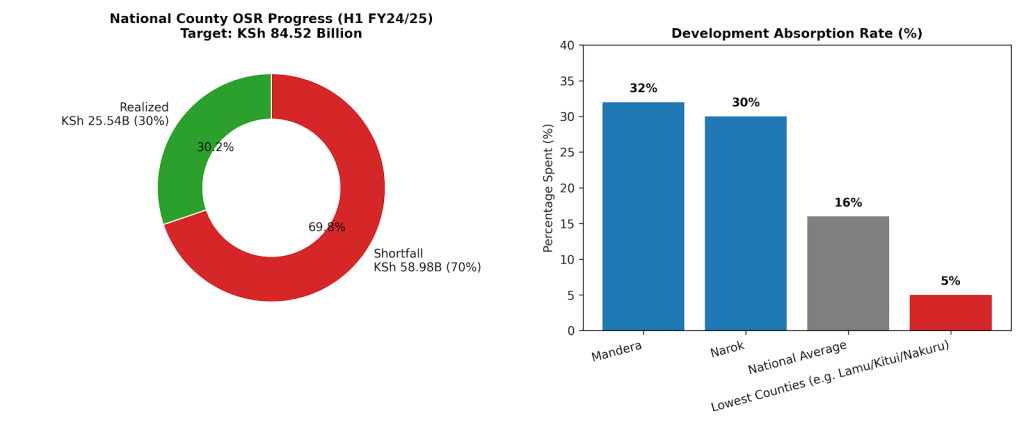
Between July and December 2024, counties collected KSh 25.54 billion in own-source revenue against an annual target of KSh 84.52 billion, meaning only 30 per cent of the expected revenue had been realised halfway through the financial year.
Although this was an improvement from KSh 19.95 billion collected during the same period in the previous financial year, the figures reveal sharp differences between counties with strong local revenue bases and those struggling to finance their operations.
Counties most at risk
The data points to two types of financial risk.
The first affects counties that generated very little revenue in absolute terms. The second affects counties that collected only a small share of what they had planned, regardless of the actual amount raised.
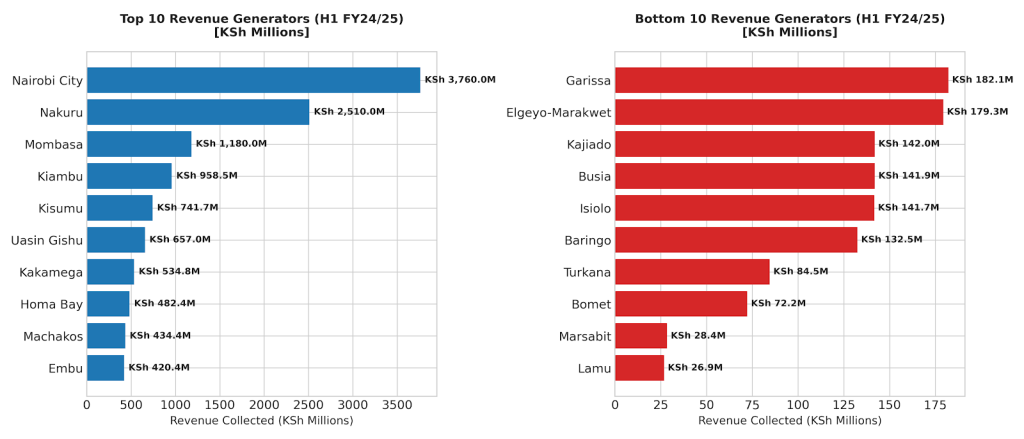
The counties trailing in revenue generated had limited locally generated funds available to support services beyond allocations from the national government.
The report also identified counties that performed poorly against their own revenue targets.
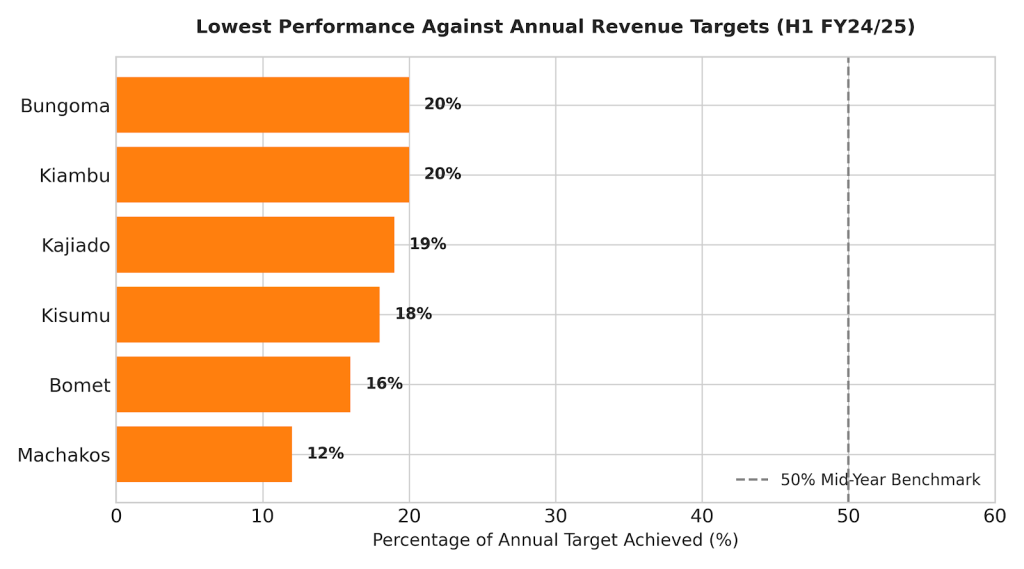
For these counties, the challenge was not only how much revenue they collected, but how far behind they were compared with what they had budgeted. Such shortfalls can disrupt planning and force counties to postpone spending.
Why own-source revenue matters
County governments rely on two main sources of funding: transfers from the national government and revenue collected locally through business permits, parking fees, land rates, market charges and other levies.
While equitable share allocations finance much of county spending, own-source revenue gives counties flexibility to respond to local priorities and meet obligations that cannot wait for national disbursements.
When local revenue falls short, the effects can quickly spread across county operations.
Pending bills continue to grow
One of the first casualties of weak revenue collection is the payment of pending bills.
Suppliers who have delivered goods or completed work may wait months before receiving payment, tying up cash that businesses need to operate. As unpaid bills accumulate, counties face increasing financial pressure and risk losing the confidence of suppliers. Contractors face delayed payments
Roads, markets, health centres and water projects depend on contractors being paid on time.
When county revenues fall below expectations, payments are often delayed, forcing some contractors to slow or suspend construction. In some cases, projects remain incomplete long after funds were initially allocated.
Delayed payments can also discourage firms from bidding for future county tenders, reducing competition and increasing project costs.
Pressure on health facilities
Health services are among the largest responsibilities devolved to county governments.
Weak revenue collection can affect the purchase of medicines, maintenance of health facilities, repair of medical equipment and expansion of healthcare infrastructure.
Although counties receive funding from the national government, poor local revenue can limit their ability to respond quickly to emerging health needs or maintain essential services.
Staff salaries under strain
Local revenue also supports recurrent expenditure in many counties.
Where collections remain below target, county governments may struggle to meet payroll obligations or delay recruitment needed to improve service delivery.
Late salary payments can affect staff morale and disrupt services in sectors such as healthcare, enforcement and county administration.
Development projects slow down
The revenue challenges were reflected in development spending.
According to the Controller of Budget, county governments spent KSh 33.60 billion on development during the first six months of the financial year, representing an absorption rate of just 16 per cent.
Despite having access to KSh 234.71 billion from equitable share allocations, cash balances, arrears and own-source revenue, a significant portion of development funds remained unspent.
Mandera and Narok recorded the highest development absorption rates at 32 per cent and 30 per cent respectively, while counties including Lamu, Kitui and Nakuru posted the lowest absorption levels.
Low development spending means residents wait longer for roads, markets, water projects, health facilities and other public infrastructure promised in county budgets.
The counties generating the most revenue
The report shows that Kenya’s largest urban economies continued to dominate local revenue collection.
However, collecting large amounts of revenue did not always translate into strong performance.
Kiambu and Machakos, for example, ranked among the top ten counties by revenue collected but still achieved only 20 per cent and 12 per cent of their annual targets respectively. This suggests that ambitious revenue projections alone do not guarantee strong financial performance.
What the data tells us
The Controller of Budget’s figures underline a wider challenge facing county governments. Many remain heavily dependent on transfers from the national government because their own revenue streams are too weak to sustain growing expenditure.
For residents, poor revenue collection is more than a budgeting issue. It can mean delayed road projects, unpaid contractors, shortages in health facilities, mounting pending bills and slower delivery of essential county services.