

For many counties in Kenya, raising enough local revenue remains a major challenge. Most depend heavily on allocations from the national government, while own-source revenue often falls short because of weak collection systems, leakages and poor accountability.
Kiambu County is now presenting a different picture.
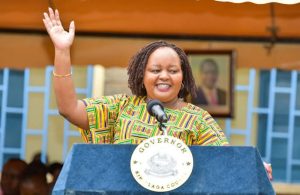
Over the last four financial years, the county has more than doubled its own-source revenue, growing collections from about Sh2.8 billion in 2022 to Sh6.5 billion in the 2025/26 financial year. The increase came without introducing new taxes or raising existing charges, according to Governor Kimani Wamatangi.
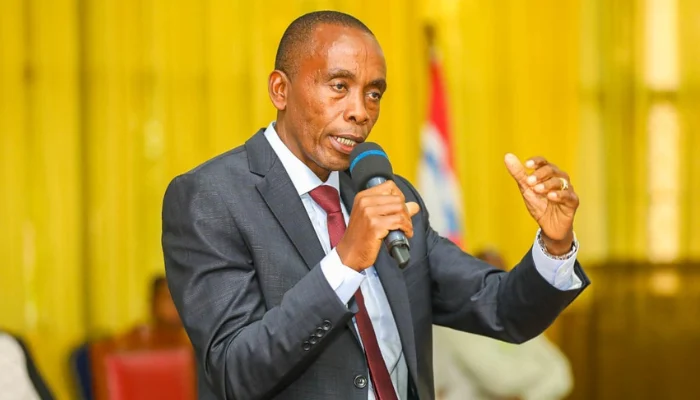
“Our target is that within the next three years, God willing, we are going to match a shilling for a shilling for every disbursement to this county and to those who have been watching to see whether the cup will fall, by 2028 this county will raise Ksh 11.5 billion plus and we shall be ensuring services in Kiambu are at the level we want,” Wamatangi stated.
So, what exactly changed?
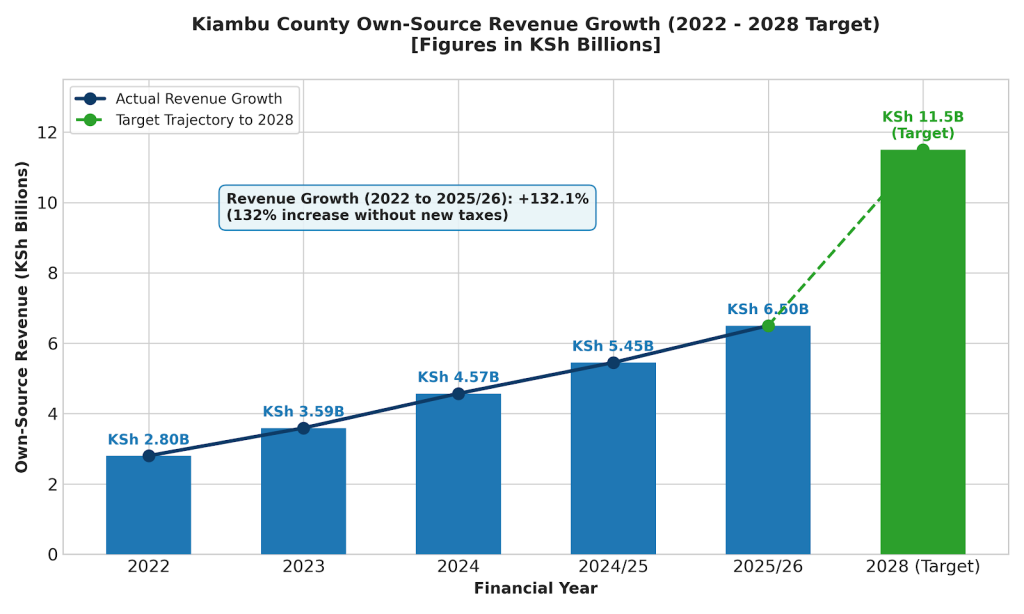
The county is now aiming to raise another Sh5 billion by 2028, with the long-term goal of matching the Sh11.5 billion it receives annually from the national government.
No new taxes, but better collection
The county government insists the increase was not driven by higher taxes.
Governor Wamatangi says the focus was on improving the way existing revenue was collected rather than asking residents and businesses to pay more.
In simple terms, the county sought to collect revenue that was already due but was previously being lost through inefficiencies.
Automation replaced manual systems
One of the biggest changes was the digitisation of revenue collection.
Instead of relying heavily on manual payments, Kiambu expanded digital platforms that allow residents and businesses to pay electronically.
Automation reduces opportunities for cash handling, speeds up transactions and creates an electronic record of every payment. This makes it easier to monitor collections and identify discrepancies.
For county officials, digital systems also provide real-time data, making it easier to track revenue performance and plan more effectively.
Closing revenue leakages
Another key reform was sealing revenue leakages.
Revenue leakages occur when money collected never reaches county accounts because of weak controls, fraud, poor record-keeping or inefficient collection systems.
Kiambu says it tightened financial controls, strengthened accountability and improved oversight across revenue collection points.
County Finance Executive Nancy Kirumba says these measures helped ensure that money collected was properly accounted for and deposited into county accounts.
The reforms also encouraged better compliance by taxpayers through simpler payment systems and improved administration. Better management, not higher charges
County officials argue that stronger financial management was just as important as automation.
They cite improved coordination among departments, tighter expenditure controls and greater accountability as factors behind the growth in collections.
Rather than introducing new taxes, the county focused on making existing systems work more efficiently.
According to the county, this demonstrates that significant revenue growth is possible when public finances are well managed.
Is there still room to collect more?
Yes.
A 2022 assessment by the Commission on Revenue Allocation estimated Kiambu’s own-source revenue potential at Sh13.95 billion.
That means the county is currently collecting less than half of what experts believe it could raise if all eligible revenue streams were fully utilised.
County officials say the estimate represents both an opportunity and a benchmark for future reforms.
Where is the extra money going?
The county says improved revenue collection has helped finance projects across several sectors.
These include the construction of 512 Early Childhood Development Education (ECDE) centres, complete with classrooms, teachers’ offices, play areas and sanitation facilities. The county has also continued providing learning materials and supporting a school feeding programme.
In healthcare, Kiambu has completed six Level 4 hospitals with a combined capacity of more than 180 beds and is building 28 Level 3 health facilities. It has also introduced telemedicine services, allowing doctors to consult specialists in the United Kingdom during certain medical procedures.
The county says medicine supplies in public health facilities have also improved.
Elsewhere, investment in solar-powered infrastructure has reduced the county’s annual electricity bill from about Sh700 million to roughly Sh290 million. Around 12,000 solar-powered streetlights have already been installed, with another 12,000 planned this financial year.
The county has also built 14 modern bus parks and continued maintaining roads despite delays in receiving funds from the Road Maintenance Levy Fund.
Can other counties copy Kiambu?
Many of the reforms introduced in Kiambu are not unique.
Digitising revenue collection, reducing cash payments, strengthening internal controls, improving accountability and sealing revenue leakages are measures that can be adopted by any county government.
However, successful implementation depends on consistent political support, investment in technology, effective oversight and a public service committed to enforcing financial discipline.
Counties with outdated manual systems or weak accountability structures may struggle to achieve similar results without broader institutional reforms.