


Kenya’s decision to support a precautionary pause on deep seabed mining could have far-reaching implications for coastal counties that depend on the ocean for fishing, tourism and livelihoods.
The Government became the 42nd country to back calls for a global pause or moratorium on deep seabed mining, arguing that more scientific evidence is needed before commercial mining of the ocean floor can proceed.
Although the position was announced during the Our Ocean Conference in June, it continues to shape Kenya’s approach to managing marine resources at a time when countries are weighing the demand for critical minerals against the need to protect ocean ecosystems.
Deep seabed mining involves extracting minerals such as cobalt, nickel and manganese from the ocean floor. Supporters say these minerals are needed for batteries and renewable energy technologies.
However, scientists and conservation groups warn that mining could damage fragile marine habitats that remain largely unexplored.
Speaking during the conference, Principal Secretary for Mining Harry Kimtai said Kenya believes scientific research has not advanced enough to justify commercial deep seabed mining.
“The interest in deep seabed mining is advancing faster than the architecture that guides it,” he said, adding that Kenya supports a precautionary pause until decisions can be based on sufficient scientific evidence.
Kimtai also said Kenya has made progress in mapping its marine resources but has not begun offshore seabed exploration.
He called for greater investment in scientific research and promoted a circular economy, which focuses on reusing and recycling minerals to reduce pressure on natural resources.
For coastal counties, the Government’s position could help safeguard marine biodiversity that supports fisheries, tourism and the blue economy.
Healthy ocean ecosystems also protect coastlines and provide income for thousands of households.
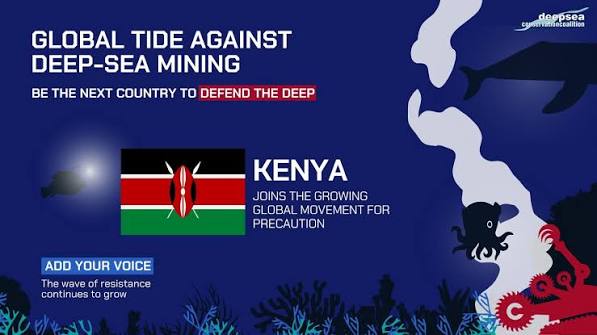
Environmental organisations have welcomed the move. WWF-Kenya Chief Executive Officer Jackson Kiplagat said Kenya had demonstrated leadership by prioritising science and supporting international efforts to protect the marine environment.
As global discussions on deep seabed mining continue, Kenya’s position signals that environmental protection and scientific evidence should remain central to decisions affecting the country’s marine resources.