

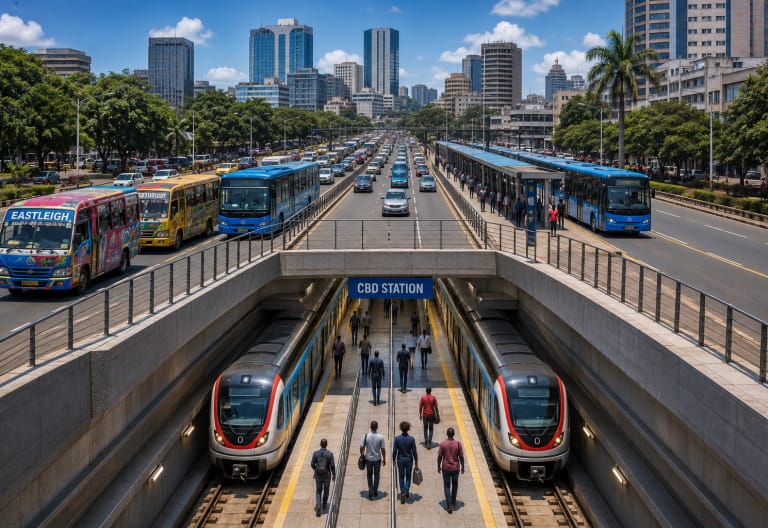
For decades, every major transport plan for Nairobi has promised to solve traffic congestion. Ring roads, bypasses, commuter rail improvements and Bus Rapid Transit (BRT) have all been presented as long-term answers.
Now the city has set its sights even higher.
The Nairobi County Executive Committee has approved the implementation framework for the Nairobi Metropolitan Mass Rapid Transit System (NMRTS), a project that includes the capital’s first underground metro. Governor Johnson Sakaja says it will transform Nairobi into a “20-minute city”, where people can travel across the capital in less than 20 minutes.
It is an ambitious vision. But can Nairobi realistically build an underground railway?
Why does Nairobi need an underground metro?
Nairobi’s population continues to grow while the road network struggles to keep pace.
Every weekday, hundreds of thousands of commuters travel into the Central Business District from Eastlands, Westlands, Lang’ata, Ngong Road, Embakasi and other suburbs. Much of this movement depends on matatus and private vehicles competing for limited road space.
The result is familiar, long traffic jams, lost working hours, high fuel consumption and unreliable public transport.
An underground metro would remove a significant number of passengers from the roads by carrying large volumes of people beneath the city, leaving more road space for buses, emergency vehicles and commercial traffic.
It would also complement commuter rail, Bus Rapid Transit and non-motorised transport instead of replacing them.
Why build underground instead of above ground?
Constructing new railway lines through Nairobi’s CBD presents a major challenge because the city is already densely developed.
Acquiring land for surface rail would require demolishing buildings and compensating property owners, making the project both expensive and disruptive.
An underground system avoids many of these problems by running beneath existing roads and buildings.
Cities such as London, Singapore, Paris and Tokyo have relied on underground rail because expanding road space in busy urban centres became impossible.
How much could it cost?
Governor Sakaja estimates that Phase One alone could cost more than Sh1 trillion (about US$7.8 billion).
While direct comparisons are difficult because each city has different geology, labour costs and construction methods, underground metro systems are among the most expensive transport projects in the world because of extensive tunnelling and station construction.
The final cost would depend on:
- the length of underground tunnels
- the number of stations
- land acquisition requirements
- imported equipment
- financing costs
- exchange rate fluctuations
- inflation during construction.
Large infrastructure projects often become more expensive than initial estimates, making careful project management essential.
Who would pay for it?
The county government cannot finance a project of this size on its own. According to Sakaja, funding could come from several sources, including:
- the National Government
- development partners
- pension funds
- private investors
- land value capture around future stations
- Transit-Oriented Development projects.
Land value capture is already used internationally. As property prices increase around new transport stations, governments recover part of that increase through taxes, leases or development agreements to help finance the infrastructure.
Private investment could also support commercial developments around stations.
Even so, securing more than Sh1 trillion would require long-term financial commitments and strong investor confidence.
What approvals are still needed?
County approval does not mean construction can begin immediately.
Several important steps remain before work starts.
These include:
- approval by the National Government
- agreement on financing
- establishment of the project management structures
- procurement of contractors
- environmental approvals
- detailed engineering designs
- legal agreements between government agencies
- possible parliamentary approval for national funding commitments.
The project will also require close coordination between Nairobi County, the Ministry of Transport, Kenya Railways and other national agencies.
Could it really reduce congestion?
Potentially, yes but only if it forms part of a wider integrated transport network.
Experience from other cities shows that metro systems work best when passengers can easily transfer between trains, buses, commuter rail, walking and cycling routes using a single transport network.
Nairobi has discussed mass transit for decades.
Plans dating back to 1948, 1972 and the 2014 Nairobi Integrated Urban Development Master Plan all proposed modern public transport, yet none progressed to construction.
Whether the underground metro moves from blueprint to reality will ultimately depend on sustained political commitment, financing and careful execution over many years.