



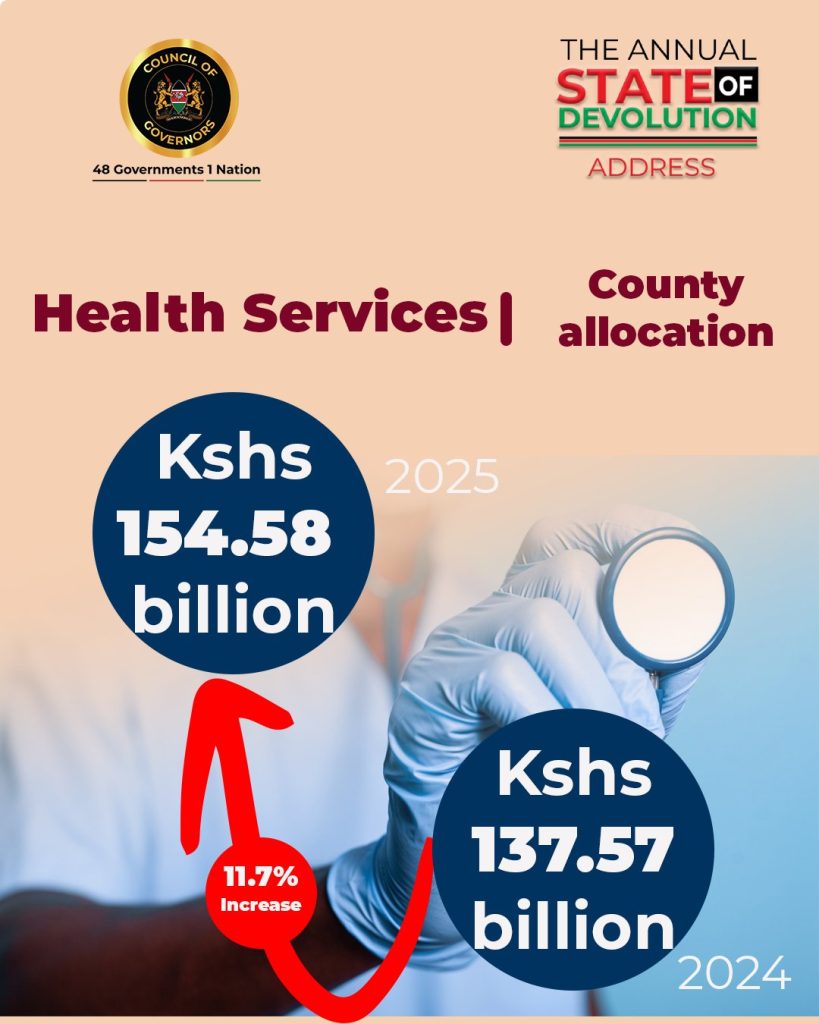
County governments spent Ksh154.6 billion on health in the 2025/26 financial year, with new figures showing gains in maternal and newborn care as counties take on a bigger role in expanding access to healthcare.
The investment, highlighted by the Council of Governors (CoG) in its latest State of Devolution assessment, comes as enrolment under the Social Health Authority (SHA) passes 30.1 million people.
The CoG says maternal deaths declined by 6.8 per cent, while neonatal deaths also fell during the period. It attributed the progress partly to increased investment in primary healthcare, referral systems and maternal services.
Counties have also expanded Primary Care Networks, with 277 now operational across the country.
The networks are intended to strengthen the connection between community health services, dispensaries, health centres and referral hospitals, allowing patients to access care closer to home while improving referrals for more complex cases.
Another development is the expansion of Maternal and Perinatal Death Surveillance and Response (MPDSR) reviews.
All 47 counties are now conducting weekly reviews aimed at examining maternal and newborn deaths, identifying gaps in care and putting measures in place to prevent similar deaths.
ALSO READ:Leaders warn against divisive politics in one of Kenya’s most diverse county
The health workforce challenge
Despite the increased investment, counties say the gains could be difficult to sustain if the health workforce continues to shrink.
The loss of thousands of health workers remains a major concern for county health systems, which depend heavily on doctors, nurses, clinical officers, community health workers and other frontline staff.
More funding for facilities and equipment does not necessarily translate into better services if there are not enough health workers to operate those facilities.
This creates a challenge for counties as they seek to expand primary healthcare while also maintaining county and referral hospitals.
The issue also raises questions about how counties are prioritising their health budgets and whether increased spending is reaching the areas where residents experience the greatest gaps in care.
SHA shifts pressure to county health systems
The enrolment of more than 30.1 million people under SHA is another major development for county healthcare.
The transition from the National Health Insurance Fund (NHIF) to SHA is intended to widen health coverage and reduce the amount households pay directly for medical care.
But the success of the system will also depend on what happens at county level.
Most Kenyans seeking public healthcare interact with county-run facilities, making counties an important link between health financing and actual access to services.
For residents, SHA enrolment therefore matters most when it translates into functioning health facilities, medicines, health workers and timely treatment.
Beyond hospitals: investing in the systems around healthcare
The CoG’s figures also point to investments beyond health facilities.
Counties invested Ksh31 billion in roads during the 2025/26 financial year and now manage about 76 per cent of Kenya’s road network, according to the council.
While roads are not a health-sector investment, they can directly affect access to healthcare, particularly in rural areas where poor connectivity can delay referrals and make it harder for patients to reach health facilities.
The CoG also highlighted county spending on renewable energy, clean cooking and rural electrification, saying these investments are improving connectivity and economic opportunities.
ALSO READ:Why Maji Mazuri Market Matters and How Traders Will Get Business Spaces
What the numbers tell us about devolution

The latest figures provide a useful measure of how county governments are using their responsibilities more than a decade after devolution began.
Health remains one of the largest functions assigned to counties, covering primary healthcare, public health facilities and county referral hospitals.
The increase in health spending, expansion of Primary Care Networks and decline in maternal deaths suggest areas where county investment may be producing measurable results.
But the figures also point to challenges that cannot be solved through higher budgets alone.
The shortage of health workers, the effectiveness of SHA at facility level and the ability of counties to maintain infrastructure and essential services will determine whether these gains can be sustained.













Leave a Reply